Regulation
Medicare Advantage Contracts Rated Five Stars Fall to 15 for 2027, From 38 in 2024
By Insurance Wire Staff, . Insurance Wire.
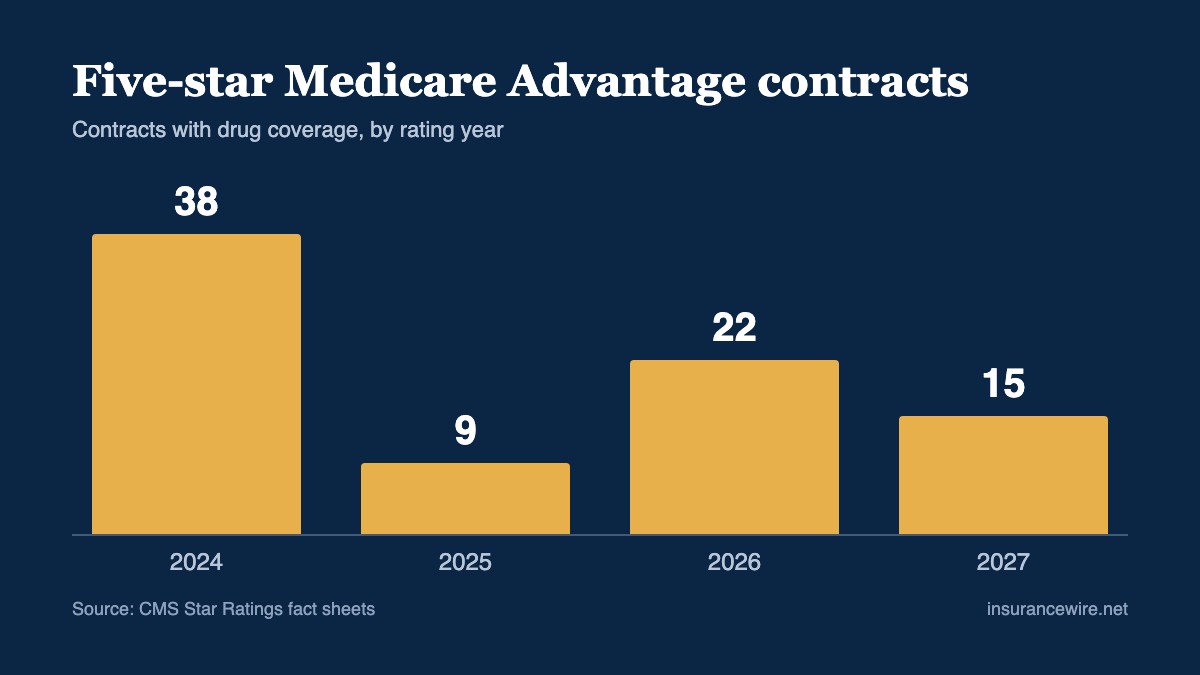
Fifteen Medicare Advantage contracts earned the top five-star rating in the federal government's 2027 Star Ratings, released October 8, 2026, down from 38 in the 2024 ratings, according to the Centers for Medicare & Medicaid Services (CMS) fact sheet. The ratings decide which private Medicare plans collect federal bonus payments in 2028, and they shape what the 35 million people enrolled in Medicare Advantage this year see when they compare plans during open enrollment, which runs from October 15 to December 7.
Raghu Santhanam, a healthcare finance and analytics executive who posts on LinkedIn as Raghu S., argues in a LinkedIn post and a longer companion article, both published October 15, that the decline says more about how the ratings are graded than about the care plans deliver. Here is what the data confirms, what remains his view, and what it means for carriers and agents.
What the numbers show
CMS rates plans by "contract," an agreement with the government that can cover several individual plans. The counts here are for Medicare Advantage contracts that include drug coverage, the bulk of the market. CMS's own table shows five-star contracts at 38 for 2024, 9 for 2025, 22 for 2026 and 15 for 2027. That is a 60% drop over three rating years, but not a steady slide. The 2026 figure reflects ratings CMS updated in June and July 2026.
The field also shrank, from 545 rated contracts for 2024 to 508 for 2027. For 2027, 188 contracts, about 37%, earned four stars or more, down from about 44% for 2026, according to CMS and Becker's Payer Issues. Weighted by enrollment, about 71% of members are in contracts rated four stars or higher, which means the higher-rated contracts are, on average, the bigger ones.
Why the bar moves
Each contract is scored on up to 43 measures, from cancer screenings to customer service. For each one, CMS sets "cut points," the score thresholds that decide whether a plan earns one star or five. Those thresholds are not fixed: CMS says they are recalculated each year based on performance during the measurement period. A plan can improve and still lose a star if its rivals improve faster.
That is the core of Santhanam's argument. He says the industry has not got worse at caring for patients and has improved on most clinical measures, and he calls Stars "an annually re-priced financial instrument" that finance and quality teams should model together. Insurance Wire could not independently confirm his claim about clinical performance. CMS's fact sheet reports average star scores for each measure, which are relative grades, not the underlying rates of care.
Independent analysis supports part of his picture. Actuarial firm Wakely, reviewing the 2026 thresholds, found cut points at the highest levels in the program's history. It credited ongoing quality improvement, but also two method changes: "guardrails" that limit how far a threshold can move in a year, and the phased use of a statistical technique that drops extreme outliers before thresholds are set. Part of the rising bar, in other words, is the formula itself. Before this year's release, Pam Price of the consultancy AArete told Healthcare Finance News she expected ratings to stay flat because of how cut points had changed.
Where the money is
Contracts rated four stars or higher get a higher federal payment benchmark, usually five percentage points more and ten in certain "double bonus" counties, according to KFF. KFF estimates the bonus program will cost at least $13.4 billion in 2026, more than four times the $3.0 billion of 2015. The share of Medicare Advantage enrollees in bonus-eligible plans fell to 68% in 2026 from 75% in 2025.
Santhanam reads the tougher thresholds as CMS managing a bonus pool that has grown faster than the agency wants. That is his interpretation. CMS's fact sheet gives no such reason and describes year-to-year rating changes as "normal and expected." He also predicts that the five-star group will keep shrinking and that more small and newer insurers will exit or consolidate before the next bidding cycle. That is a forecast, not an established trend.
Insurance Wire's take: what to watch
A falling count of five-star contracts is not, on its own, evidence of worse care, nor proof of better care graded more harshly; a relative grading system cannot separate the two. The five-star tier is also thin. Five of the 15 contracts belong to Longevity Health Plan and each has fewer than 1,500 members, per Becker's, and only about 2% of enrollees are in five-star contracts, per CMS. For plan finances, the four-star line matters far more than the five-star count.
Three things are worth watching. First, the 2028 ratings, which industry consultants quoted by Healthcare Finance News expect to reflect CMS's overhaul of the measures. Second, the 2029 ratings, when CMS will remove several administrative measures; KFF reports the change is projected to raise Medicare Advantage spending by $18.6 billion over ten years, partly because more plans are expected to qualify for bonuses. If that projection holds, it would cut against the forecast of an ever-smaller top tier. Third, for agents and brokers, ratings can move sharply from one year to the next, so comparisons for 2027 coverage should rest on the 2027 ratings now shown on Medicare Plan Finder, not last year's.
Sources
1. CMS, "2027 Medicare Advantage and Part D Star Ratings" fact sheet, October 8, 2026 2. Raghu S. (Raghu Santhanam), LinkedIn post, October 15, 2026 3. Raghu Santhanam, LinkedIn article, October 15, 2026 4. Becker's Payer Issues, "Medicare Advantage plans with 5 stars in 2027," October 8, 2026 5. Wakely, "Pointing the Way: Summary of 2026 Star Rating Cut Points" 6. Healthcare Finance News, "Why 2027 Medicare Advantage star ratings are expected to remain flat," October 7, 2026 7. KFF, "Medicare Will Spend More Than $13 Billion on the Medicare Advantage Quality Bonus Program in 2026," updated August 12, 2026
Insurance Wire provides news and information, not insurance, legal, or financial advice. Consult a qualified professional about your specific needs.